Oyster Bay is on the Strait of Georgia , not far from Campbell River, and on the way to Courtenay. I don't know the exact specifics , but that doesn't matter. Just start driving along the Island Hwy and you can't miss it. Usually at this time of year it's darker and drearier. This year, it's like we've missed winter entirely.
In the 1930's the west side of Oyster Bay was a place where workers waited in a camp to be hired to work the timber of the area.
A man named Al Simpson, constructed a causeway, sinking parts of ships to shelter the area from the fierce storms in winter.
In 1944 the timber rights were sold, but with everything dwindling, and the storms battering the area, the camp was closed down by the early 1950's.
All the buildings were taken away. It has since been transformed into a habitat.
Waterfowl, eagles, migratory birds....
In the 80's there was talk about turning the area into a coal port, or a marina. Neither of which came into existence.
In 1989 the District worked with the Oyster Bay Park Association and by 1996 this small area ( no more than 4 kms approximately) was turned into a wildlife refuge.
Most of the invasive plant species were removed, replaced with native plants. There are many signs reminding visitors to not take anything from the area. that includes shells as well, or any of the wood and logs.
It is a perfect place for photography, especially on a clear day when you can see the coast mountains.It's one of my favourite places. The trails are easy to walk, the beach is sandy and goes on forever and ever......
Showing posts with label Oyster Bay. Show all posts
Friday, March 6, 2015
Saturday, August 2, 2014
FROM PIER to BAY
Sundown at the Pier. Sundown at Oyster Bay, Campbell River. Quick. Grab a camera. Grab your friends, and family, and toddle down to the ocean. But hurry, the sun sets a little faster every day.
Beautiful down at the Pier. In perfect light .............
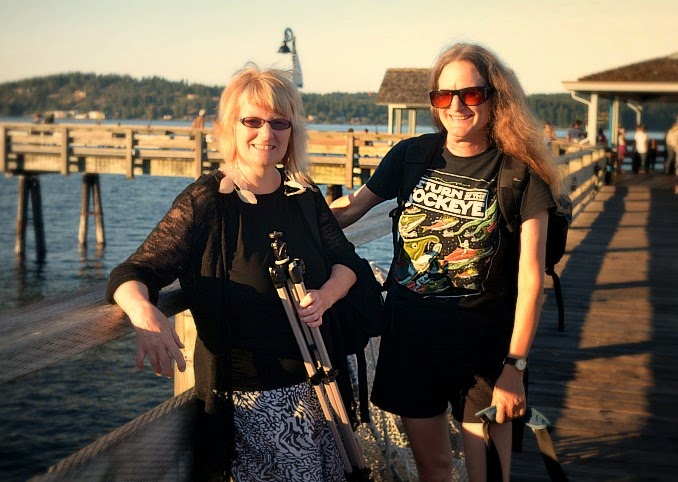
This week we got to go from the Pier to Oyster Bay with visiting friends, Ruth and Ian.We were so loaded down with camera gear, it was hard to walk. So Ruth offered to pack it along for us.


Way to go, Ruth!
Ian and Ruth had earlier been sharing with us their inspiring travel photography, from the Phillipines, Quangxi, Quinghai Province, China, Bali, Vijayanagan, Cambodia, to name a few. ( I'm sure I missed a few places, or have mispelled them).I learned so much from Ian's photography lessons, that we visited a local camera shop so I could pick up a couple of circular polarizing filters for my camera lenses. What a difference. Glare on water is cut down, sky is vibrantly transformed......


The polarizing filter looks a lot like a lens from a sunglass, and when you rotate it, you can see changes in light. As a result the polarizing filter cuts out certain light to the camera, so you have to use longer shutter speeds, and try to keep the sun to your side and not at your back or shoot into the sun. But even if you do, the effects are surprising. And the night we went to the Pier, and Oyster Bay, the sunset did not disappoint.


About 158 species of birds have been found in the park. Winter birding at its best. It is along what is called the Pacific Flyway, a route for millions of birds that migrate. Mallard, American Wigeon, Ducks, Teals, and Northern Pintail,Glaucous-winged Gull, Mew Gull and Thayer's Gull. Ducks include Surf Scoter, Harlequin , Bufflehead, Goldeneye, plus Cormorants. I have also seen Swallows roosting in the pylons along the shore.And eagles, of course, sitting high up . Watching.


The mud flats give way to rocky beach, to sand bars and huge sky. This area was a relief camp at one time for out of work iron workers, and was built up with houses, back in the 30's. The camp was closed in the 1950's, and in the 1980's the area escaped several developers. By 1989 Oyster Bay Park Association decided to set it up as a wildlife refuge.
And to think this bay was once considered for a coal port..................

Kayaks drift up and down the passage, against a backdrop of mountains from the coast.
And the area is quiet , pristine, beautiful, and clean. With nothing but big sky and a few happy humans exploring its shores.
(Get more information about Winter Birding from http://islandnature.ca/)
Beautiful down at the Pier. In perfect light .............
This week we got to go from the Pier to Oyster Bay with visiting friends, Ruth and Ian.We were so loaded down with camera gear, it was hard to walk. So Ruth offered to pack it along for us.
Way to go, Ruth!
Ian and Ruth had earlier been sharing with us their inspiring travel photography, from the Phillipines, Quangxi, Quinghai Province, China, Bali, Vijayanagan, Cambodia, to name a few. ( I'm sure I missed a few places, or have mispelled them).I learned so much from Ian's photography lessons, that we visited a local camera shop so I could pick up a couple of circular polarizing filters for my camera lenses. What a difference. Glare on water is cut down, sky is vibrantly transformed......
The polarizing filter looks a lot like a lens from a sunglass, and when you rotate it, you can see changes in light. As a result the polarizing filter cuts out certain light to the camera, so you have to use longer shutter speeds, and try to keep the sun to your side and not at your back or shoot into the sun. But even if you do, the effects are surprising. And the night we went to the Pier, and Oyster Bay, the sunset did not disappoint.
At Salmon Point we were treated to something unique. The fishing boats were out in droves. And so were the leaping salmon. Hard to catch , and really odd to see: hordes of sockeye on their run, throwing themselves out of the water.The only pic I could get was this one, with the leaping salmon in the centre , water ruffled beneath, as it flew intothe air.
That old saying that the "fishing was so good they were leaping into the boat", is true. You could hear the slap on the water as the salmon smacked back into the ocean.
We finally made it to Oyster Bay. Beautiful shoreline park between Courteany and Campbell River. A small area, about 4 and half acres, that takes about 15 minutes to toodle around.About 158 species of birds have been found in the park. Winter birding at its best. It is along what is called the Pacific Flyway, a route for millions of birds that migrate. Mallard, American Wigeon, Ducks, Teals, and Northern Pintail,Glaucous-winged Gull, Mew Gull and Thayer's Gull. Ducks include Surf Scoter, Harlequin , Bufflehead, Goldeneye, plus Cormorants. I have also seen Swallows roosting in the pylons along the shore.And eagles, of course, sitting high up . Watching.
The mud flats give way to rocky beach, to sand bars and huge sky. This area was a relief camp at one time for out of work iron workers, and was built up with houses, back in the 30's. The camp was closed in the 1950's, and in the 1980's the area escaped several developers. By 1989 Oyster Bay Park Association decided to set it up as a wildlife refuge.
And to think this bay was once considered for a coal port..................
Kayaks drift up and down the passage, against a backdrop of mountains from the coast.
And the area is quiet , pristine, beautiful, and clean. With nothing but big sky and a few happy humans exploring its shores.
(Get more information about Winter Birding from http://islandnature.ca/)
Labels:
Discovery Pier,
migrating birds,
Ocean,
Oyster Bay,
Polarizing Lens,
Salmon
Subscribe to:
Posts (Atom)


